Fresh on presentation at international conference: ARVO-Salt Lake City, Utah 2025
Ms恒和团队已经有了新的医疗数据提出了在ARVO会议在2025年。
一个演示看的:
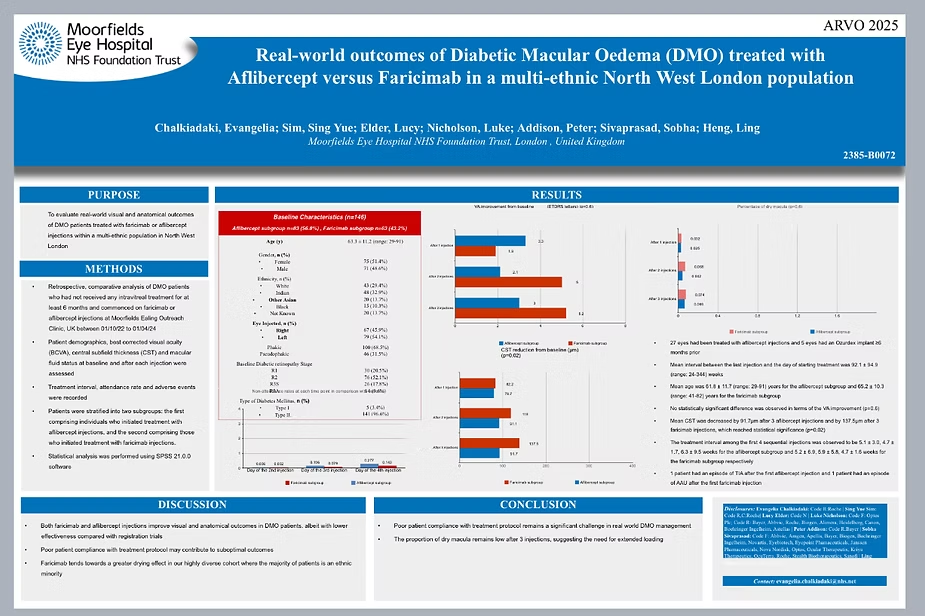
Preliminary Results of a Real-World Comparative Analysis of Anatomical and Visual Outcomes in Diabetic Macular Oedema (DMO) Patients Treated with Faricimab or Aflibercept Injections
This study aims to compare real-world anatomical and visual outcomes of DMO patients commenced on 法瑞西单抗 或 阿柏西普 injection at a tertiary care center in the United Kingdom (UK).
Retrospective analysis of all DMO patients who had not received any intravitreal treatment for at least 6 months and commenced on Faricimab or Aflibercept at Moorfields Ealing outreach (UK) between 1 October 2022 to 1 April 2024.
患者的人口统计, 糖尿病视网膜病变 stage, attendance rate, visual acuity (VA),central subfield thickness(CST) and macular fluid status at baseline and after each injection were assessed.
Treatment intervals and adverse events were also recorded. Statistical analysis was performed using SPSS 21.0.0 software.
A total of 146 DMO eyes were included in the study,divided into two subgroups: 83 eyes initiated on aflibercept and 63 on Faricimab. Mean age was 63.3±11.2years with females being 51.4%. 25.3% were Caucasian and 32.9% were Indians.
Baseline mean VA and CST were 62.9±15.3ETDRS letters and 387.0±90.1μm for the aflibercept subgroup, and 59.4±17.5ETDRS letters and 427.5±114.6μm for the Faricimab subgroup.
VA improvements compared to baseline after each of the first 3 injections were +3.3, +2.1 and +3.0 ETDRS letters for aflibercept and +1.9, +5.0 and +5.2 ETDRS letters for Faricimab (p=0.6). CST reductions compared to baseline after each of the first 3 injections were -78.7, -91.1 and -91.7μm for Aflibercept and -82.2, -118.0, -137.5μm for Faricimab (p=0.02 after 3 injections).
The proportion of dry macula after each injection were 2.5%, 4.2%, 6.6% for the Aflibercept subgroup and 3.2%, 6.8% and 7.4% for the Faricimab subgroup respectively (p=0.6). Non attendance rates for the 2nd, 3rd and 4th injection were 3.6%, 15.6%, 27.7% for Aflibercept and 3.1%, 7.9% and 14.2% for Faricimab. No cases of anterior uveitis or endophthalmitis were observed.
This study showed that both Faricimab and Aflibercept loading injections result in visual and anatomical improvement for DMO in real-world settings, although the proportion of dry macula remains low after three injections suggesting the need for longer loading phase. Faricimab tended towards more rapid improvement but ceiling effect in the aflibercept group cannot be excluded. Further studies are needed to compare these treatments in real-world practice.